
'The Naga Hills region, Nagaland and Manipur, have had the most uncaring and corrupt state governments with little to show on the ground despite the nation's highest per capita development expenditure,' says Mohan Guruswamy.

The Manmohan Singh government's rush to pass the Food Security Bill reflects extreme paucity of logic and action, says Neeta Kolhatkar

'The TDP walking out of the NDA is a victory for the YSRCP.' 'The YSRCP wanted it to happen so that it would help them in coming elections.'

More, many market gurus expect the Sensex to reach 30,000 levels by December and 40,000-45,000 in three to four years.
It, however, lags other states on crucial parameters such as health care and rural poverty.

West Bengal was the second-most industrialised state in terms of value added and first in terms of number of factories and employment even in the mid-1960s. With a severe and long process of deindustrialisation, it lost its primacy.
Veterans bemoan the 'lack of intention' shown by the Modi sarkar, who seem to have reneged on their poll promise.

If oil prices rise, the government would face an uncomfortable political decision.

The plan of UID/Aadhaar-based surveillance does not end with the collection of fingerprints and iris scan, it goes quite beyond it and poses a lethal threat to the idea of India, says Gopal Krishna.
'There is tension between the zones all the time.'

Instead of a consumption stimulus the government must address the NPA issue with a war footing and invest in infrastructure, affordable housing and exports, says Sanjeev Nayyar.

Modi government has to come up with a robust economic agenda to impress the masses.

NDA government has shunned populism.

The Survey projected growth rate of 7-7.75 per cent for 2016-17 with downside risks due to weak global economic scenario.


A K Bhattacharya digs into the yet-to-be-public report on ways to curb black money and finds out that Modi's next moves could include action on dabba trading, hawala, and education.
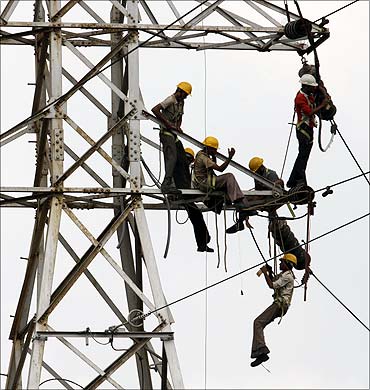
With their balance sheets under stress, private companies have lost interest in them.

RCom is expected to have a 50% stake, Aircel 40% and MTS 10%

20 years ago this day, May 11, 1998, India conducted its second nuclear test at Pokharan in Rajasthan. In a fascinating interview on Rediff.com, K Subrahmanyam revealed how Indian PMs reacted to nuclear ambitions.
Raghuram Rajan speaks on the unscheduled rate cut.

Are we adopting an idea whose time has come and gone? My feeling is, yes, says ex-banker C Joseph Chacko in the fourth article of the series on inflation targeting.

More lucrative routinely prescribed drugs are at higher risk of failing quality standards

'Think about this: A widow of a jawan is drawing only Rs 3,500. If OROP is implemented, she will get additional Rs 1,500. These poor girls are young and have no source of income; they are trying their best to just make ends meet. It is the pain of these situations that has driven me to this.' 'We don't want to put pressure on the government -- that's not our intention. We have full faith in our prime minister. We are asking for a meeting with him, and when we get that, we are sure he will not only give us what we are asking for, but 10 per cent extra.' Major General Satbir Singh, who headed the OROP agitation at Jantar Mantar, speaks out.

The government has provided a long-term vision.

No account of the 1962 war could be complete without Maxwell's authoritative analysis. Which is why we are reprinting this article which was run on Rediff.com in June 2001.

With facts and figures, the CAG report has highlighted how Gujarat was far from a role model for states across India, and that the progress made in this province in western India in improving agriculture, education, healthcare and empowerment of women and children, was not exactly creditable, says Paranjoy Guha Thakurta.
 © 2026 Rediff.com - Advertise with us - Disclaimer - Privacy Policy - Sitemap - Feedback - About us - Terms of use - Grievances